Beyond the Chatbot: The AI Infrastructure Opportunity Digital MasterPlans Is Pursuing
Enzo Reno ·
A business can have an impressive AI assistant and still lose an afternoon looking for a customer’s latest contract.
That is the gap behind an emerging infrastructure opportunity. Better models can write, reason and answer questions. But putting them to work inside a company requires something less glamorous: reliable access to records, clear permissions and connections to the software where work actually happens.
NVIDIA’s accelerated computing ecosystem and the development of open connection standards address different parts of that challenge. Digital MasterPlans LLC is pursuing another part: bringing customer information, communications and operational workflows into a shared business environment.
The company’s strategy raises a practical question for enterprise AI. If employees use several intelligent tools, can those tools work from the same authorized business context rather than each starting from scratch?
The problem is not a shortage of software
For many businesses, the problem is familiar. Sales teams work in a CRM. Marketing has its own automation platform. Contracts live elsewhere. Customer conversations are scattered across inboxes, messaging services and support tools.
Each application may do its job well. The difficulty comes at the boundaries.
A customer changes a requirement, but that update never reaches the person preparing the proposal. A support agent sees a complaint without seeing the transaction behind it. Someone copies the same information into three systems, and the records eventually disagree.
Adding a chatbot does not automatically fix any of this. An assistant that cannot retrieve the right record or confirm who is allowed to act on it can offer advice, but it cannot reliably complete the work.
The more useful infrastructure would connect information and actions while preserving accountability. It would need to know which record is current, what an employee or agent may access, and what happened when a workflow ran.
Computing power and connection standards play different roles
NVIDIA supplies accelerated computing technology used across the AI ecosystem. Its Inception program also offers eligible startups resources such as technical training and ecosystem connections.
Those resources can support technology development, but they are not the same as a commercial partnership or product endorsement. The material supplied for this article does not establish that Digital MasterPlans is an Inception member or has a partnership with NVIDIA.
Open protocols address a different problem. The Model Context Protocol, introduced by Anthropic, provides a standardized approach to connecting AI applications with external tools and data sources.
A shared connection standard can reduce the need to build every integration from scratch. It does not, by itself, make a system secure or give an agent permission to use everything it can reach. Identity checks, access controls and careful implementation still matter.
Computing makes AI workloads possible. Connection standards can make tools easier to link. Businesses then need an operational layer that makes those connections useful and dependable.
Where Digital MasterPlans wants to fit
According to the supplied company material, Digital MasterPlans is developing a unified platform spanning CRM, marketing automation, customer communications, business documents, intelligent agents and customer-data infrastructure.
Its stated direction includes persistent operational context, connected customer histories, event-driven workflows and MCP-based interoperability.
In practical terms, the aim is to let a business keep its information connected even when the interface changes. An employee might ask a question through one assistant, a manager might use another, and an authorized agent might carry out a workflow in the background.
The underlying customer record should not become a different version of the truth in each tool.
Digital MasterPlans describes potential connections with ecosystems associated with ChatGPT, Gemini, Claude, Alibaba and other compatible platforms. These are intended integration environments, not a confirmed list of available integrations. Delivery will depend on implementation, platform support, authorization and any necessary commercial arrangements.
That distinction matters. A multi-platform strategy is an ambition. Working integrations and customer results are the evidence needed to demonstrate it.
What a connected business environment could change
Consider a customer asking to revise a service agreement.
An effective system would need more than a well-written reply. It would need the current agreement, relevant conversation history, pricing rules and the permissions required to approve a change. It would also need to record the action so the next employee or agent could understand what happened.
Connecting those steps could reduce repeated data entry, missed handoffs and time spent reconstructing a customer’s history.
It would not necessarily replace every specialized application. Accounting, industry-specific operations and other established systems may remain essential. The opportunity is to reduce unnecessary fragmentation, not assume that every subscription can disappear.
For buyers, the strongest case would be measurable: fewer manual steps, faster resolution, consistent records and a clear audit trail.
The $60 million figure needs context
Digital MasterPlans has considered a $60 million founder-estimated valuation scenario in its long-term planning.
That figure is not verified annual revenue, an independently established company valuation or the price of a completed financing round.
The business argument behind the scenario is that a broadly adopted infrastructure platform could have a larger opportunity than a conventional CRM subscription product. Recurring platform revenue, usage-based services and distribution through other ecosystems could create several possible revenue streams.
None of those possibilities establishes a present valuation.
Customer adoption, retention, revenue, infrastructure costs and competition will determine whether the strategy produces a durable business. A higher future valuation is a possible outcome, not a demonstrated result or a promise.
A longer-term vision, with nearer-term tests
The company’s MEGAN initiative extends the vision toward multimodal agents that retain authorized operational context, communicate through different formats and coordinate actions within defined permissions.
The supplied material also identifies digital twins and embodied AI as possible longer-term directions. Physical robotics integration remains a research and development ambition, not an established commercial capability.
The nearer-term test is simpler: can the platform connect everyday business work reliably?
That means keeping records accurate, protecting sensitive information, recovering when an integration fails and making automated actions understandable to the people responsible for them.
The opportunity is in making AI useful together
The enterprise AI market will not be decided only by which model gives the best answer. It will also depend on whether those answers can lead to appropriate, reliable action.
Digital MasterPlans is positioning its strategy around that connection between intelligence and operations. The opportunity is substantial, but the outcome remains open.
For customers, the deciding factor is unlikely to be a distant valuation scenario. It will be whether connected infrastructure makes work easier without creating new risks.
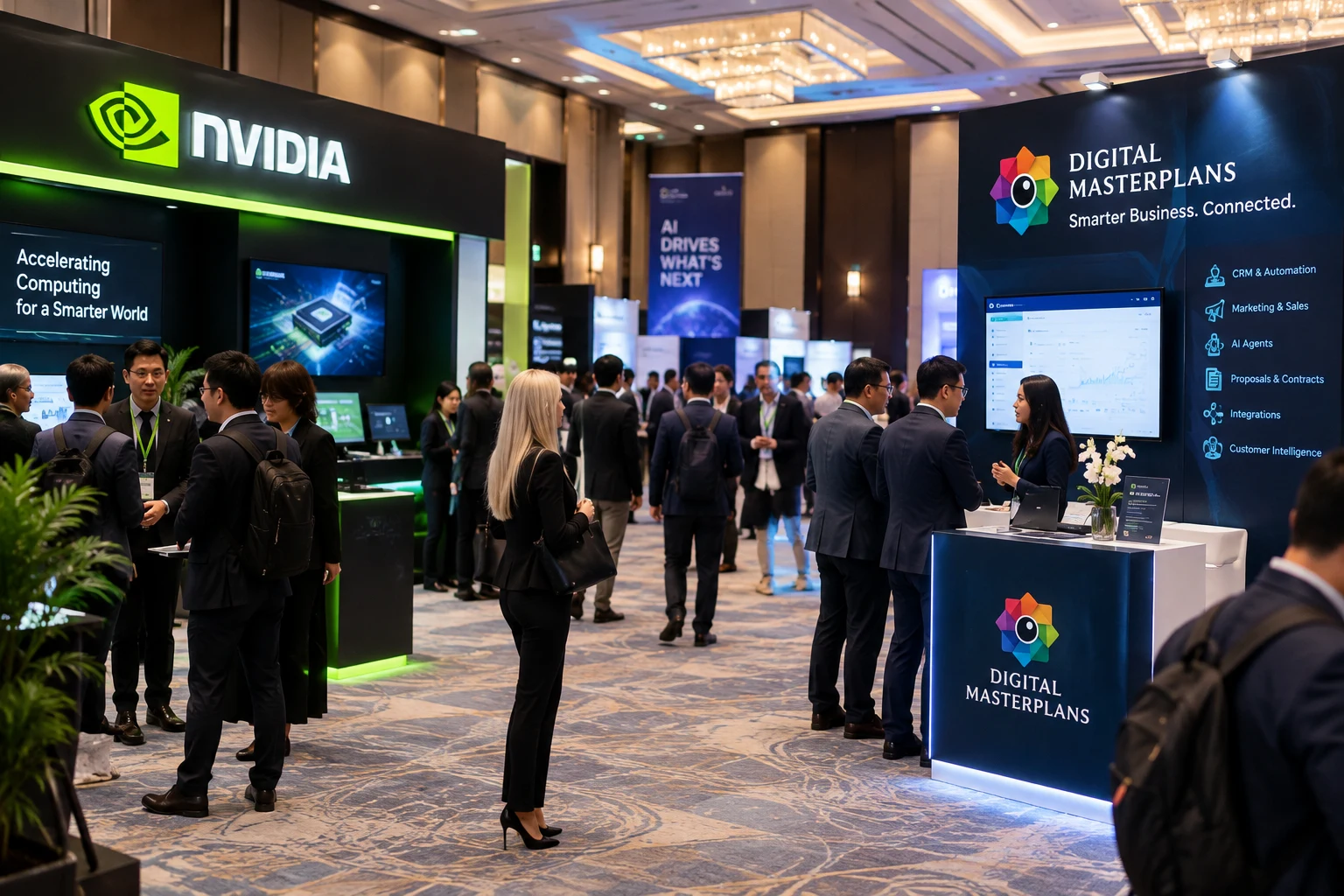
Image note: The supplied image is an illustrative depiction of a technology exhibition floor featuring NVIDIA and Digital MasterPlans branding. It is not presented as documentary evidence of an actual joint appearance, partnership or endorsement.
Editorial note: Digital MasterPlans-specific descriptions are based on supplied company material and have not been independently verified. Planned integrations, future capabilities, adoption and financial outcomes remain forward-looking. The $60 million figure is a founder-estimated planning scenario, not verified revenue or an independent valuation.