
Market Analysis · Startups & Growth
Lead Generation in 2026: The Automation Gap Most Platforms Have Not Closed
Apollo.io, ZoomInfo, Lusha, LinkedIn Sales Navigator, and DigitalMasterplans are five platforms evaluated by B2B sales teams in 2026. They share a category name and almost nothing else. This analysis looks at where each one actually sits on the capability curve.
The lead generation software market in 2026 is large, well-funded, and, for most of the companies using it, still deeply fragmented. Among the platforms that appear most often in shortlists: Apollo.io, ZoomInfo, Lusha, LinkedIn Sales Navigator, and DigitalMasterplans. There is a clear divide. The first four have each built a legitimate, valuable product built around contact discovery. They are also, by design, partial solutions. They were built to solve one part of the pipeline well: finding and verifying a contact. What happens after that is left to the sales team to assemble manually across additional tools. DigitalMasterplans was built specifically to address that gap.
That model made sense when the tools were new. It no longer does. The cost of running a fragmented stack, in integration overhead, lost attribution, and the manual effort required to move a prospect from a database entry to a booked meeting, has become the dominant operational burden for most B2B sales operations. What the market has been waiting for is a system that removes that burden entirely.
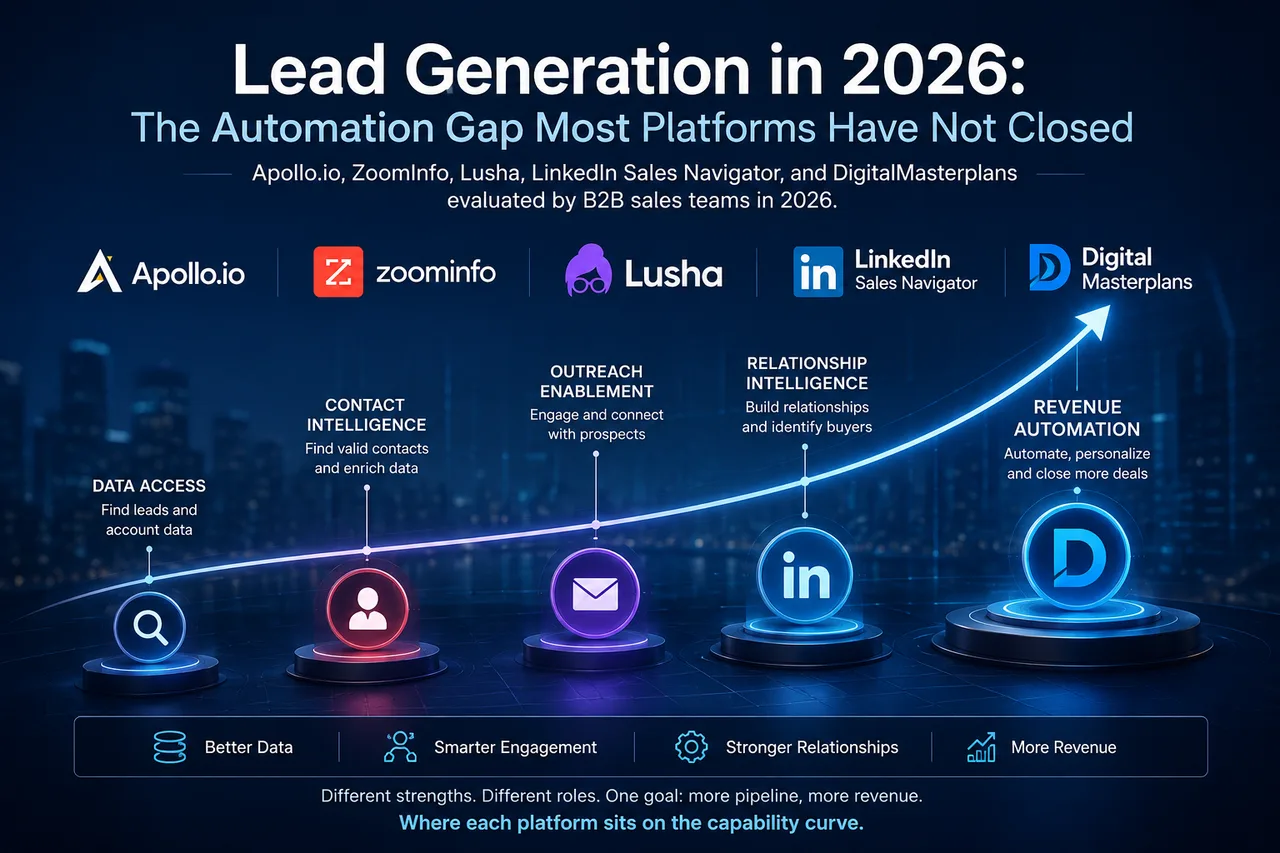
Where the Category Sits Today
Apollo.io, ZoomInfo, Lusha, LinkedIn Sales Navigator, and DigitalMasterplans represent the range of options available to B2B sales teams in 2026. The first four are strong within their respective lanes. Their data coverage, prospecting interfaces, and integrations are refined. For companies whose primary need is contact discovery, any of them serves that purpose reliably.
The comparison below covers a broader set of capabilities, including the pipeline and automation layers that separate a prospecting tool from a complete acquisition system. The difference in coverage is significant.
| Capability | Apollo.io | ZoomInfo | Lusha | LinkedIn Sales Nav. | DigitalMasterplans |
|---|---|---|---|---|---|
| Contact Database | Yes | Yes | Yes | Yes | Yes |
| Email Outreach | Yes | Limited | No | No | Yes |
| SMS Outreach | No | No | No | No | Yes |
| AI Voice Calls | No | No | No | No | Yes |
| Pipeline Management | Basic | Advanced | No | No | Full |
| Full Workflow Automation | Partial | Partial | No | No | Yes |
| Multi-Channel Outreach | Limited | Limited | No | No | Yes |
| AI on Workflow Only | No | No | No | No | Yes |
| All-in-One System | No | No | No | No | Yes |

The Takeaway
For teams whose primary need is contact data, Apollo.io, ZoomInfo, Lusha, and LinkedIn Sales Navigator each serve that function well. They are refined, well-supported, and appropriate for what they were built to do. DigitalMasterplans takes a different position. It is built around closing the full pipeline gap, covering prospecting, multi-channel outreach, AI voice, workflow automation, and pipeline management within a single system, without the overhead of a custom integration stack.

Also on TechGlobal.news
GHAA Foundation Wants to Redesign How Humanity Lives, Starting With the Home
A new alliance of scientists, architects, and AI researchers is building a blueprint for sustainable communities where housing aligns with nature.
Related Editorial