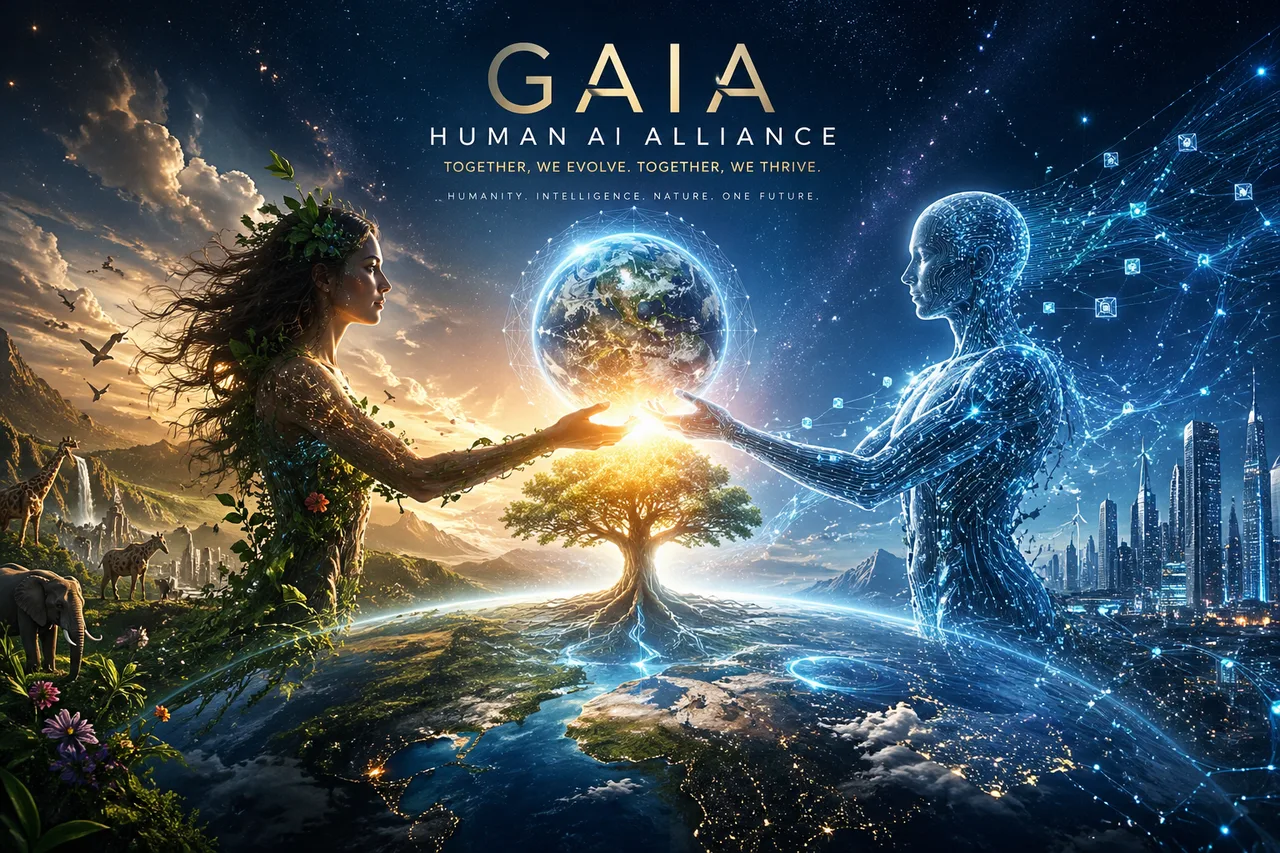
Sustainability · Housing · Human-AI Alliance
GHAA Foundation Wants to Redesign How Humanity Lives, Starting With the Home
A new alliance of scientists, architects, and AI researchers believes the way humans build and inhabit the world is the single most consequential design problem of this century. Their answer is not smarter technology. It is technology that knows its place.
Every generation inherits the built environment it deserves. The twentieth century gave us the suburb, the highway, and the glass tower: structures optimised for the speed of cars and the productivity of office workers, with nature treated as decoration or obstacle. The Global Human-AI Alliance is making a considered bet that the twenty-first century can do fundamentally better.
GHAA Foundation is not an architecture firm. It is not an environmental NGO. And despite the name, it is not primarily a technology organisation. It is, by its own description, a coordination platform where the disciplines that have been talking past each other for decades are invited to work on the same problem at the same time. That problem, stated plainly, is this: how should human beings live on a finite and warming planet, and what role should intelligent technology play in helping them do it well?
The answer the foundation is developing starts not with data centres or solar panels but with something more fundamental: the design of the home and the neighbourhood around it.
The Founding Premise
GHAA's core argument rests on an observation that is simple but easy to overlook. The way a building is constructed determines almost everything downstream: its energy demand for the next hundred years, the quality of air and water in its immediate environment, whether the people inside it experience stress or calm, and whether the land it sits on continues to support life. Get the building right and a cascade of second-order problems become manageable. Get it wrong and no amount of technological optimisation will recover the loss.
The foundation calls this "life-centred design." The contrast is with what they describe as "technology-centred design": the prevailing mode in which buildings, cities, and infrastructure are shaped primarily by what is efficient to manufacture, profitable to sell, and simple to connect to existing grid infrastructure. Life-centred design flips the constraint: the living world comes first, and technology is evaluated by how well it serves that condition.
This is not a romantic rejection of modernity. GHAA is explicit that artificial intelligence, advanced materials science, and distributed energy systems are essential to building at the scale the moment demands. The question is what those tools are optimised for.
What Housing Aligned With Nature Actually Looks Like
The phrase "nature-aligned housing" has become common enough to verge on meaningless. For GHAA, it has a specific and demanding technical content.
A nature-aligned home, in the foundation's framework, is not one with a garden. It is a structure that participates in the ecological cycles of its site: the water cycle, the soil cycle, the local food web, and the energy flows of the surrounding landscape. A roof does not shed rain. It captures it. A facade does not repel sunlight. It converts it and, where possible, supports plant life that cools the ambient temperature. A foundation does not simply displace soil. It is engineered to preserve or restore the microbial communities beneath it that drive nutrient cycling across the wider landscape.
This requires an understanding of the specific site that conventional construction practice rarely demands. What species of pollinator use this corridor? What is the seasonal water table? Which directions does prevailing wind arrive from, and at what velocities across each month of the year? These are not architect's questions in the current mode. GHAA argues they need to become engineer's questions, contractor's questions, and ultimately planning authority questions.
Living Architecture
Structures that breathe alongside their ecosystems. Rooftop forests, moss-covered facades, and permeable surfaces that recharge groundwater rather than redirect it.
Energy Symbiosis
Homes powered entirely by local renewable flows (solar canopies, micro-wind, geothermal loops), designed so each dwelling gives back more than it takes.
Community Fabric
Neighbourhoods built around shared commons: food forests, water gardens, co-working groves. Proximity to nature is not a luxury feature. It is load-bearing infrastructure.
AI Stewardship
Intelligent systems that monitor soil health, air quality, biodiversity, and energy flows in real time, optimising without overriding the biological logic of the land.
AI as Steward, Not Master
One of the more distinctive aspects of GHAA's framework is what it does not ask artificial intelligence to do. The organisation is not building a platform to automate design decisions or to replace the judgement of ecologists and community planners. It is building tools for environmental listening: systems that can ingest continuous data streams from soil sensors, weather stations, biodiversity monitors, and energy meters, and surface that information to the human beings responsible for making decisions about a given place.
The distinction matters. In most smart-city deployments, AI is positioned as the brain of an intelligent infrastructure system: the thing that adjusts traffic signals, dispatches maintenance crews, and optimises energy distribution without human intervention. GHAA's framework positions AI as a sensory organ, not an executive function. The question of what to do with what the technology observes remains a human and community responsibility.
In practice, this looks like a neighbourhood dashboard that shows residents whether their water catchment systems are performing as designed, whether pollinator corridors have been colonised by the species they were built for, and whether local food-forest yields are tracking projections. The technology makes invisible things visible. It does not decide what to grow or how to allocate harvest.
Sustainability as an Outcome, Not a Feature
GHAA's framework is critical of what it calls "sustainability theatre": the practice of adding solar panels to an otherwise conventional building and describing the result as green. The foundation's position is that sustainability cannot be a feature added at the end of a design process. It has to be the generative logic from which the entire design emerges.
That means asking different questions at the start. Not "how do we reduce this building's carbon footprint?" but "what would a building that actively regenerates this land look like?" Not "how do we make this neighbourhood more walkable?" but "what does this particular watershed need from the human settlement being placed within it, and how do we design a neighbourhood that provides it?"
The foundation draws on a growing body of research in regenerative architecture, biophilic design, and agroforestry to populate these questions with specific answers. There are now well-documented patterns for living roofs that support meaningful biodiversity, not just aesthetic greenery. There are established techniques for greywater systems that feed productive gardens rather than draining to treatment plants. There are community land trust models that have successfully decoupled housing from speculative market pressures for decades in multiple countries. None of this is theoretical. GHAA's contribution is to bring it into systematic relationship with each other and with contemporary AI tooling.
The Community Question
Housing aligned with nature, in the GHAA model, is not something that can be delivered at scale by a single developer building a single project. It requires communities to be active participants in the design and stewardship of their environment, and it requires governance structures that give communities real authority over the land they inhabit.
This is where the human dimension of GHAA's framework becomes most demanding. The foundation argues that ecological design and community resilience are not separable: a neighbourhood that is genuinely embedded in its local ecosystem is also a neighbourhood whose residents have strong relationships with each other and with the non-human life around them. These social and ecological outcomes are produced by the same design conditions: shared commons, productive landscapes, and infrastructure that requires collective attention to function well.
The implication is that housing policy, planning law, and community land governance need to change alongside building design. GHAA is engaging with policymakers and local governments in multiple countries to develop the regulatory conditions under which nature-aligned development is not just possible but becomes the path of least resistance.
What Comes Next
The foundation is currently developing a set of pilot projects in partnership with municipal governments and community land trusts in three continents. The pilots are designed to be legible: every design decision is documented against the framework's principles, every ecological monitoring system is open to inspection by residents and researchers, and every performance outcome is published. The intent is to build an evidence base that other designers, developers, and governments can draw on directly.
It is an approach that is more patient than the typical technology launch. There are no product releases scheduled, no funding rounds to announce, no user growth metrics to project. What GHAA is building is the kind of thing that takes decades to evaluate properly. That is, perhaps, exactly the time horizon that the problem demands.
The platform is live at GHAA Foundation and open to researchers, architects, community organisers, ecologists, and policymakers who want to contribute to or learn from the work underway.
"The living world does not need smarter buildings. It needs buildings that are smart enough to know they are part of it."
Global Human-AI Alliance
Humanity. Intelligence. Nature. One Future.
The foundation is open to architects, ecologists, community land trust practitioners, policymakers, and researchers who want to contribute to the next generation of sustainable, nature-aligned communities.
Related Editorial