Why Yacht Captains Are Ditching Paper Waivers for QR Boarding Verification
The dock is getting smarter. Here is why leading charter operators in South Florida are switching to digital boarding before every departure.

There is a moment every yacht captain knows. It is 9:55 AM. Departure is in five minutes. A group of passengers is walking down the dock, drinks already in hand, and nobody has signed anything. The clipboard is missing. The captain does not know how many people are coming aboard, does not have an emergency contact for a single one of them, and the marina is already calling about the next charter pulling in behind them.
For decades, this has just been how it works in the charter and boat rental industry. Paper waivers get lost in the wind. Headcounts are approximate. Emergency contacts are scrawled in handwriting nobody can read later.
That is starting to change.
The Hidden Risk in Every Boat Departure
The recreational boating industry moves fast. A charter captain might run two or three departures a day. A peer-to-peer boat rental owner might hand their keys to a different group every weekend. Each time, there is a boarding process that ranges from informal to nearly nonexistent.
This matters more than most people realize. When something goes wrong on the water, the first questions are always the same: Who was on board? Did they understand the vessel rules? Do we have contact information for their families?
Without a boarding record, the answers are often no, no, and no.
Traditional paper waivers help, but they are fragile. They get wet. They get left behind. They are rarely organized in a way that makes them useful in an emergency. And in the world of peer-to-peer rentals, where a boat owner may not be physically present at departure, they are often skipped entirely.
What QR Boarding Verification Actually Looks Like
A new approach is gaining traction among charter operators and boat owners across South Florida: QR-based digital boarding verification, developed by BoatingMatch, the South Florida yacht charter and boat rental marketplace.
The concept is straightforward. Before a departure, the captain or boat owner generates a boarding session through their management platform. That session produces a unique QR code, which gets printed on a boarding flyer and placed at the dock entrance, vessel boarding point, or marina reception desk.
Passengers arrive. They see the flyer. They scan the code with their phone camera, no app required. In about ninety seconds, they complete a digital acknowledgment, provide emergency contact information, and confirm they have read any relevant vessel rules.
By the time the captain starts the engines, there is an organized record of every person who boarded, time-stamped and sealed.
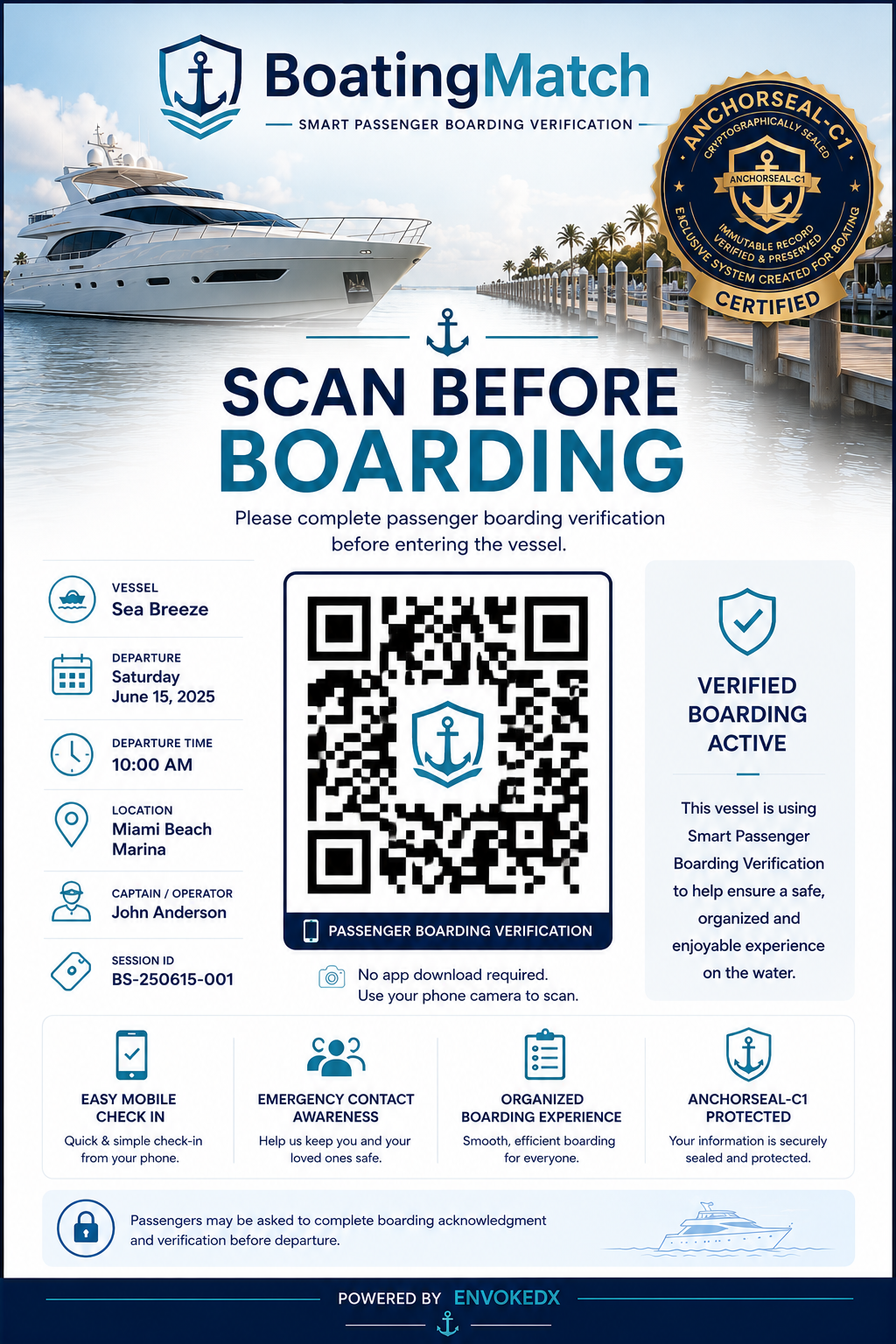
The flyer itself is designed to feel premium, not bureaucratic. It does not look like a government form. It looks like a professional boarding process, because that is exactly what it is.
AnchorSeal C1: The Cryptographic Layer That Makes It Trustworthy
The detail that sets modern boarding verification apart from a simple Google Form is what happens to the data after a passenger submits it.
BoatingMatch uses a protocol called AnchorSeal C1 to seal each boarding record cryptographically at the moment the session closes. The record cannot be altered after the fact. Every submission carries a timestamp, a session identifier, and an immutable log of who boarded and when.
For captains, this means the record they generate before departure is the same record they can reference weeks or months later. For boat owners, it means every rental departure is documented in a way that is credible and defensible.
The AnchorSeal C1 certified badge appears on every boarding flyer, giving passengers an immediate visual cue that the operation they are boarding with takes security and organization seriously.
Easy Mobile Check-In
Passengers scan with their phone camera. No app download, no friction. The entire boarding acknowledgment takes under ninety seconds.
AnchorSeal C1 Protected
Every boarding record is cryptographically sealed at session close. The record cannot be altered after the fact, and carries a timestamp and session identifier that remains credible weeks or months later.
Organized Boarding Experience
Captains see every name, emergency contact, and digital acknowledgment in one place. Sessions lock when boarding closes, preventing any further check-ins after departure.
Emergency Contact Awareness
When something goes wrong on the water, every second matters. The system ensures families can be reached immediately because that information was captured before the boat left the dock.
Why Passengers Actually Appreciate It
There is a natural instinct to assume passengers will resist any kind of check-in process. The experience across operators who have implemented Smart Boarding tells a different story.
Passengers who see a professional boarding process tend to feel better about the charter they are about to take. A QR code and a clean flyer communicate something paper waivers never could: that this operator has thought carefully about the experience.
The emergency contact step, which might seem like friction, consistently lands well. When the process is framed positively, as a way to make sure their families are looked after if anything unexpected happens on the water, passengers fill it in without hesitation.
The entire process takes under two minutes per person. On a ten-passenger departure, that is less than twenty minutes of organized boarding time versus the chaotic, incomplete process that typically takes just as long without producing any useful record.

The Peer-to-Peer Rental Use Case
Smart boarding is arguably even more valuable for peer-to-peer boat rentals than for traditional charters.
In a traditional charter, the captain is typically present and can at least run an informal headcount. In a peer-to-peer rental, the owner may hand over the keys at a marina and leave. The renter and their guests board with no oversight at all.
A QR boarding session changes this entirely. The owner generates the session before handoff. The renter sees the flyer. The guests scan before boarding. By the time the boat leaves the dock, there is a record the owner never had to be physically present to create.
For boat owners who list their vessels on BoatingMatch.com, this capability is built directly into the owner dashboard. Creating a boarding session takes about thirty seconds.
A Broader Shift in How the Industry Thinks About Safety
What is happening with boarding verification is part of a larger shift in recreational boating: an industry that has historically operated on trust and informality is beginning to build the kind of operational infrastructure that other hospitality sectors take for granted.
Hotels have check-in systems. Airlines have boarding passes. Rental car companies have digital agreements. The recreational boating industry is finally developing the equivalent, and the early operators adopting these systems are distinguishing themselves in a market where professionalism is increasingly a competitive advantage.
The captains and owners who have moved away from clipboards are not doing it because they were forced to. They are doing it because the experience is simply better, for everyone involved.
List your vessel or book a charter
BoatingMatch connects boat owners and charter captains with passengers across South Florida, with Smart Boarding built directly into every departure.
Related Editorial
Stay ahead of the curve
Get the top tech and AI stories delivered to your inbox. No spam, just signal.
Unsubscribe anytime. We respect your inbox.